


Anesthesia Billing Companies: Improving Accuracy, Compliance, and Revenue in a Complex Specialty
Introduction
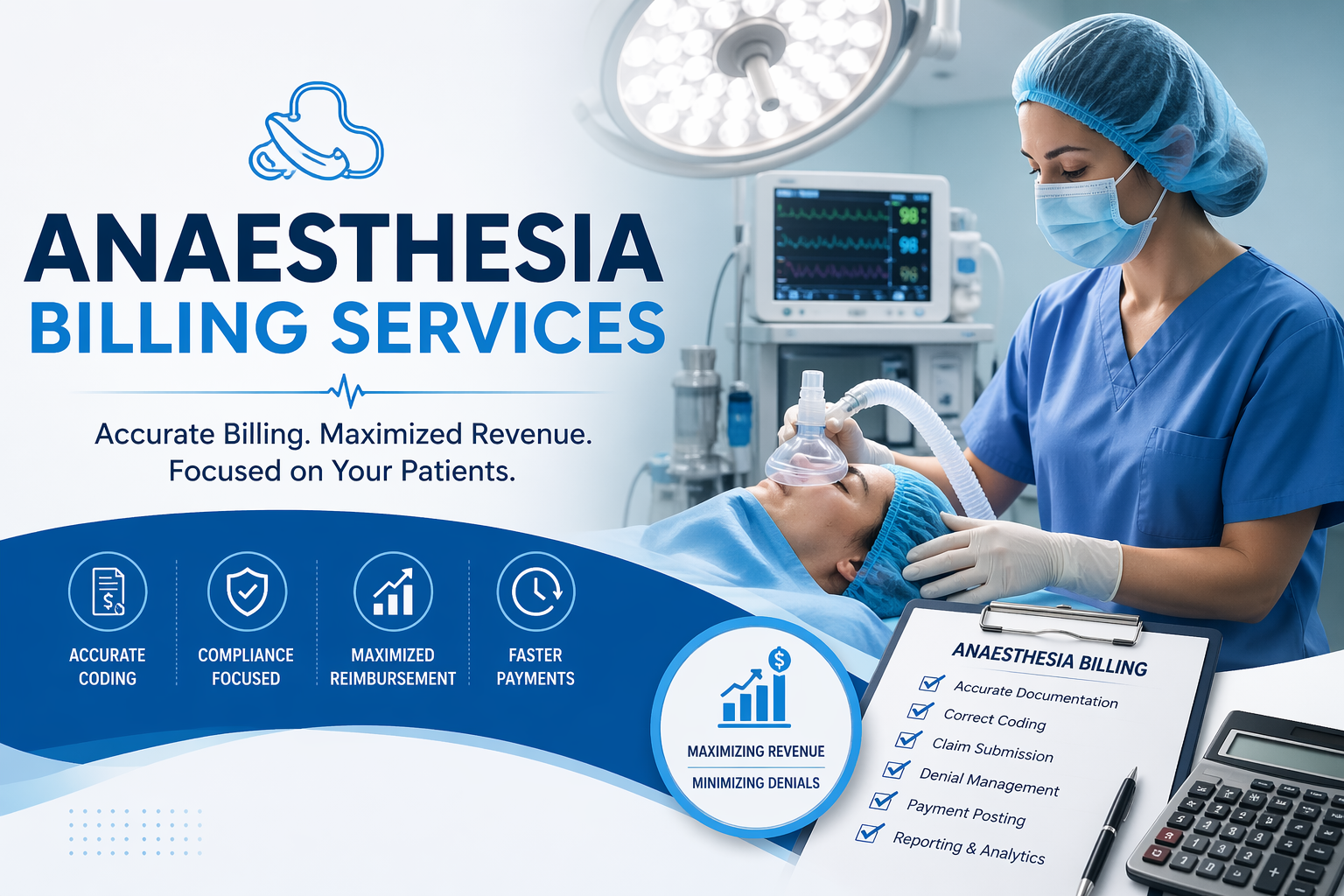
Anesthesia billing companies play a critical role in ensuring that anesthesia practices, hospitals, and ambulatory surgery centers receive accurate reimbursement for services that are highly time-sensitive and regulation-heavy. Unlike standard medical billing, anesthesia claims are calculated using a combination of base units, time units, modifiers, and payer-specific rules—making the process significantly more complex and error-prone.
A key challenge in this space is that anesthesia billing errors don’t just delay payments—they directly reduce revenue. Studies and industry analyses show that anesthesia practices can lose 15–25% of potential revenue due to billing inefficiencies and errors such as incorrect time capture, modifier misuse, and under-appealed denials . Even more concerning, a large portion of denied claims—up to 65%—are never reworked or resubmitted, leading to permanent revenue loss .
This is why many healthcare organizations rely on specialized anesthesia billing companies to manage revenue cycle operations, reduce denials, and ensure compliance with payer rules. In this blog, we will explore the major billing challenges in anesthesia, how to choose the right billing partner, strategies to reduce claim denials, and how 247 Medical Billing Services helps improve financial outcomes for anesthesia providers.
Billing Challenges in Anesthesia Revenue Cycle Management
Anesthesia billing is one of the most technically demanding areas in medical billing due to its dependency on time and strict payer guidelines. Even small documentation errors can lead to significant revenue loss.
One of the biggest challenges is time-based billing accuracy. Anesthesia reimbursement is calculated in 15-minute increments, meaning even minor discrepancies in start and stop times can result in underpayment or claim rejection. Missing documentation or rounding errors frequently lead to lost units and reduced reimbursement .
Another major issue is modifier complexity. Anesthesia claims rely heavily on modifiers such as AA, QK, QX, QY, and QZ. Incorrect usage of these modifiers is one of the leading causes of claim denials, especially when medical direction or supervision rules are misapplied .
Additional challenges include:
- Inconsistent documentation across providers and facilities
- Frequent payer policy changes and state-specific rules
- ASA crosswalk and CPT mapping errors
- Lack of proper denial follow-up and appeal systems
- Compliance risks related to audits and medical direction documentation
Because of these complexities, many general billing teams struggle to maintain accuracy, making specialized anesthesia billing companies essential for sustainable revenue management.
How to Choose the Right Anesthesia Billing Partner
Selecting the right anesthesia billing companies can significantly impact revenue performance, denial rates, and operational efficiency. A strong billing partner should not only process claims but actively optimize the entire revenue cycle.
Key factors to consider include:
- Anesthesia specialization: Ensure the company exclusively or primarily handles anesthesia billing rather than general medical billing.
- Clean claim rate performance: Look for providers with a high first-pass claim acceptance rate (ideally 95% or higher).
- Denial management system: The company should actively track, analyze, and appeal denied claims—not just resubmit them.
- Technology integration: Advanced tools for time tracking, modifier validation, and automated claim scrubbing are essential.
- Compliance expertise: Strong knowledge of CMS rules, payer policies, and HIPAA regulations is non-negotiable.
- Transparent reporting: Real-time dashboards for AR, collections, and denial trends improve financial visibility.
- Dedicated anesthesia billing team: Trained coders and billers who understand anesthesia-specific workflows.
Choosing the right partner ensures fewer errors, faster reimbursements, and improved financial stability.
How to Reduce Anesthesia Claim Denials
Reducing denials requires a proactive, structured approach rather than reactive claim corrections. Here are the most effective strategies:
1. Improve Time Capture Accuracy
Ensure precise documentation of anesthesia start and stop times. Even small discrepancies can lead to underpayments or rejections.
2. Standardize Modifier Usage
Train billing teams and providers to correctly apply anesthesia modifiers such as QK and QX based on medical direction rules.
3. Conduct Pre-Bill Audits
Review claims before submission to catch missing documentation, incorrect codes, or inconsistent records.
4. Strengthen Eligibility Verification
Verify insurance coverage and authorization requirements before procedures to prevent avoidable denials.
5. Track and Appeal Every Denial
Establish a structured denial management workflow. Many practices lose revenue simply because denied claims are never reworked.
6. Monitor Payer Rule Changes
Insurance companies frequently update anesthesia billing guidelines. Staying current prevents systematic claim errors.
HIPAA Compliance and Technology in Anesthesia Billing
Modern anesthesia billing companies must operate within strict HIPAA compliance standards while leveraging advanced technology to improve accuracy and efficiency.
HIPAA compliance ensures that patient data is securely handled throughout the billing lifecycle. This includes encrypted data storage, secure transmission of claims, and restricted access controls for billing personnel.
Technology also plays a major role in improving anesthesia billing outcomes:
- Automated coding validation tools reduce human error in claim submission
- AI-driven claim scrubbing systems detect missing modifiers and documentation gaps
- Integrated EHR and billing platforms streamline data flow between providers and billing teams
- Analytics dashboards help identify denial trends and revenue leakage
These technologies not only improve compliance but also significantly reduce administrative burden and revenue loss.
How 247 Medical Billing Services Helps Anesthesia Practices
247 Medical Billing Services specializes in delivering end-to-end revenue cycle management solutions designed to support complex specialties like anesthesia. The company focuses on improving claim accuracy, reducing denials, and maximizing reimbursement through a combination of expert billing staff and technology-driven workflows.
Key advantages include:
- Dedicated expertise in anesthesia billing workflows
- Real-time claim scrubbing to prevent errors before submission
- Structured denial management and appeals process
- Accurate time unit and modifier validation systems
- Compliance-focused billing aligned with HIPAA and payer rules
- Transparent reporting for financial performance tracking
By partnering with 247 Medical Billing Services, anesthesia providers gain a billing infrastructure designed to eliminate inefficiencies and protect revenue. This is especially valuable in a specialty where even small billing mistakes can lead to significant financial losses.
For many practices, outsourcing to experienced anesthesia billing companies is not just an operational decision—it is a financial strategy to ensure long-term sustainability and growth.
Conclusion
Anesthesia billing is one of the most complex revenue cycle processes in healthcare due to its reliance on precise time tracking, modifier accuracy, and strict payer rules. Errors in any of these areas can lead to significant revenue loss, with industry data showing that practices may lose up to 25% of potential earnings due to billing inefficiencies.
This is why working with specialized anesthesia billing companies is essential for modern healthcare organizations. The right billing partner helps reduce denials, improve compliance, and ensure faster reimbursements through structured workflows and advanced technology.
Organizations like 247 Medical Billing Services provide the expertise and systems needed to manage this complexity effectively, allowing anesthesia providers to focus more on patient care and less on administrative challenges.

 English
 Arabic
 French
 Spanish
 Portuguese
 Deutsch
 Turkish
 Dutch
Dutch
 Italiano
 Russian
 Romaian
 Portuguese (Brazil)
